Wood Pressed Groundnut Oil vs Refined Oil: Which Is Better for Cooking?
Walk into any Indian kitchen and you’ll find groundnut oil somewhere — on the stove, in the pickle jar, or sitting in a steel tin passed down from someone’s mother. But today, there are two very different versions of this oil on the market: wood-pressed (cold-pressed) groundnut oil and refined groundnut oil.
They look similar. They’re both called groundnut oil. But they are not the same thing.
This post breaks down the real differences — in nutrition, taste, smoke point, processing, and health impact — so you can make an informed choice for your family’s cooking.

What Is Wood Pressed Groundnut Oil?
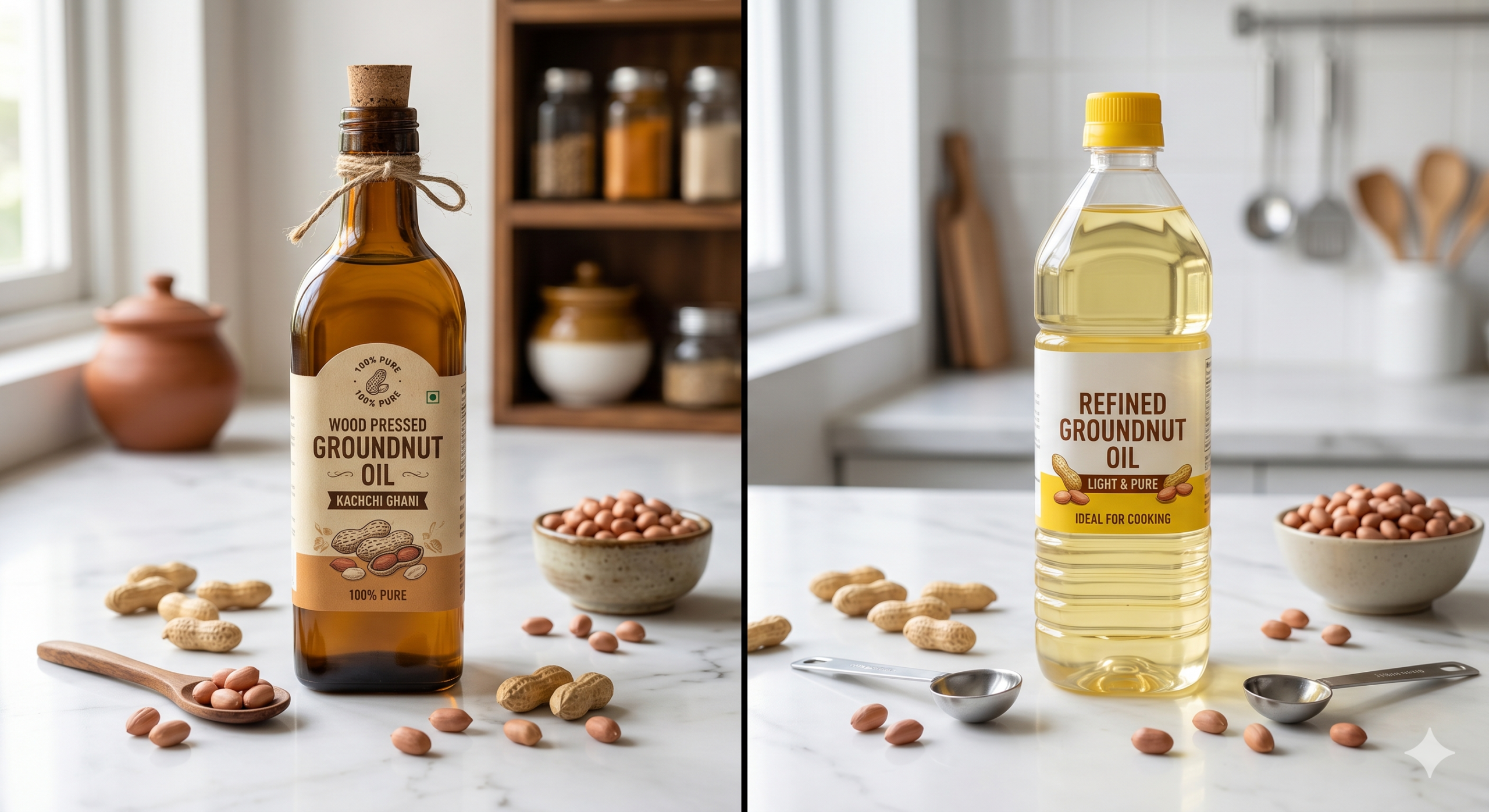
Wood pressed groundnut oil, also called kachi ghani oil or cold pressed groundnut oil, is made by crushing groundnut seeds in a traditional wooden churner (the ghani or kolhu) at low speeds and low temperatures.
No heat is applied. No chemicals are used. The oil flows out naturally and is then filtered through gravity — which is exactly how oil was made in Indian homes for centuries.
The result is an oil that retains its natural colour, aroma, nutrients, and flavour — exactly as nature intended.
What Is Refined Groundnut Oil?
Refined groundnut oil goes through an industrial process involving:
- High heat extraction (expeller pressing or solvent extraction using hexane)
- Degumming to remove phospholipids
- Neutralisation with sodium hydroxide (caustic soda)
- Bleaching with activated clay to remove colour
- Deodorisation at temperatures above 200°C to remove the natural smell
The goal is to produce a clear, shelf-stable oil that looks consistent on a supermarket shelf. But this multi-step process strips away much of what made the original groundnut nutritious.
The Key Differences: Side by Side
| Feature | Wood Pressed Groundnut Oil | Refined Groundnut Oil |
|---|---|---|
| Extraction method | Traditional ghani / cold press | Chemical solvent + high heat |
| Chemicals used | None | Hexane solvent, caustic soda |
| Natural nutrients | Preserved (Vit E, antioxidants) | Largely destroyed |
| Colour | Golden / amber | Pale yellow / clear |
| Aroma | Rich, nutty, authentic | Odourless (removed) |
| Taste | Strong, flavourful | Bland / neutral |
| Smoke point | ~160–170°C | ~230°C (heat-processed) |
| Shelf life | 6–12 months | 18–24 months (preservatives) |
| Adulteration risk | Traceable, minimal | Higher in unbranded variants |
| Price | Higher (small-batch, artisan) | Lower (mass-produced)) |
Why Nutrients Matter More Than You Think
To understand why this matters, here is what refined oil processing actually destroys:
Vitamin E (tocopherols): Groundnuts are naturally rich in vitamin E, a powerful antioxidant that protects cells from damage. High-temperature deodorization during refining significantly degrades this. Wood-pressed oil retains it.
Natural antioxidants: Polyphenols present in raw groundnuts are heat-sensitive. They protect against inflammation and oxidative stress. Refined oil loses most of these during bleaching and deodorization.
Phytosterols: These plant compounds help reduce LDL (bad) cholesterol naturally. Refining reduces phytosterol content considerably.
Resveratrol: Found in groundnut skin and seed, this compound has been linked to heart health. It does not survive industrial refining.
How Wood Pressed Groundnut Oil Preserves Natural Nutrients
When you cook with wood-pressed groundnut oil, you are not just adding fat to your food—you are adding a nutrient profile. When you cook with refined oil, you are adding processed fat, often with residues from the refining process.
What About the Smoke Point Concern?
This is the most common argument in favor of refined oil: “Refined oil has a higher smoke point, so it’s safer for frying.”
Let’s address this directly.
Wood-pressed groundnut oil has a smoke point of approximately 160–170°C. Refined groundnut oil reaches around 230°C. For deep frying at very high temperatures, this difference does matter.
However, most Indian home cooking — tadka, sautéing, shallow frying, and even moderate deep frying — happens between 150°C and 180°C. Wood-pressed groundnut oil handles this range comfortably.
More importantly, when refined oils are heated to their high smoke points repeatedly, the process of oxidation creates harmful compounds, including aldehydes and trans fats, that have been linked to inflammation and cardiovascular issues. A lower smoke point oil Indian households use within its safe range is a healthier choice than a high smoke point oil pushed to its limits.
The practical answer: For everyday cooking—curries, stir-fries, tadkas, rice dishes, and pickles—wood-pressed groundnut oil is excellent. For occasional high-heat deep frying, you can either use it at moderate temperatures or simply keep a separate small quantity of a high-smoke-point fat for those instances.
Taste: This One Is No Contest
If you grew up in a South Indian home, you already know this.
The aroma of fresh groundnut oil heating in an iron kadai is unforgettable.
In fact, it instantly reminds you of traditional home cooking.
On the other hand, refined oil has almost no aroma or character.
As a result, food tastes flatter and less authentic
The Chemical Residue Question
Cold-pressed / wood-pressed oils use zero solvents. We extract oil purely by mechanical pressure.
Refined oils manufactured using hexane extraction may carry trace hexane residues. Hexane is a petroleum-derived solvent. While regulatory limits exist, the fact that a solvent was part of the production process at all is a concern for health-conscious consumers—especially those buying for children and elderly family members.
Is Wood-Pressed Oil Worth the Higher Price?
Let’s reframe this question. The real cost comparison is not ₹X per liter. It is ₹X per meal cooked versus the long-term cost of poor nutrition.
Wood-pressed groundnut oil is typically priced 40–60% higher than refined oil. But consider:
- A 1-litre bottle lasts an average family 3–4 weeks for regular cooking
- The cost difference per meal is often ₹3–5
- You are paying for zero chemicals; wood pressing retains nutrients, authentic taste, and a product made by a small MSME-approved producer—not a mass-scale factory
For families that have made the switch, the reasons they stay with wood-pressed oil are consistent: better taste, trust in the ingredients, and the peace of mind that comes from knowing exactly how their cooking oil was made.
Why Srikruti Naturals Wood-Pressed Groundnut Oil?
At Srikruti Naturals, our groundnut oil is:
- We extract wood-pressed oil using traditional wooden press methods. — no heat, no chemicals, no shortcuts
- MSME Government of India approved—a verified, accountable business, not an unregulated seller
- Filtered through gravity only—no bleaching, no deodorisation, no additives
- Stored in food-grade steel containers and delivered in food-grade packaging
- Made to order—we do not hold large stocks of pre-processed oil waiting on a shelf
Every bottle carries the aroma, colour, and nutrient profile of freshly pressed groundnuts.
The Verdict for Wood-Pressed Groundnut Oil: Nutrition & Health Benefits
It is more nutritious, free of chemical residues, richer in flavor, and made using a process that has sustained Indian families for generations. The slightly higher price is a small and worthwhile investment in what goes into your family’s food every single day.
Refined oil wins on price, shelf life, and very-high-heat frying. For everything else—and for families that care about what is actually in their food—wood-pressed groundnut oil is the clear answer.
Ready to Make the Switch?
Order fresh wood-pressed groundnut oil directly from Srikruti Naturals. All our oils meet FSSAI approved food safety standards. Zero chemicals. Delivered to your door in Hyderabad.
📞 Call or WhatsApp: 9912770600
🛒 Order online: srikrutinaturals.com/