You have decided to switch away from refined oil. Good decision. But now you are standing in front of a shelf — or scrolling through an online store — staring at cold pressed groundnut, wood pressed sesame, kachi ghani mustard, and several other options. Which is the best wood pressed oil for cooking in India? That is the question this guide answers.
We will compare the most popular wood pressed cooking oils available today — based on smoke point, flavour, health benefits, and which cooking styles they suit best — so you can buy with complete confidence.
So which is the best wood pressed oil for cooking in India? That is exactly what this guide answers — oil by oil, use case by use case
| Quick Answer: There is no single ‘best’ oil. The best wood pressed oil depends on what you cook. Groundnut oil for everyday frying, sesame oil for South Indian tadka, coconut oil for Kerala dishes, mustard oil for North Indian cooking, and sunflower oil for a neutral everyday option. Read on for the full comparison |
Best Wood Pressed Oil for Cooking in India (2026) — Which One Should You Buy?
Refined oils are extracted using high heat and chemical solvents like hexane. This process strips out natural antioxidants, vitamins, and healthy fats — exactly the nutrients you want from cooking oil.
Wood pressed oils (also called kachi ghani, chekku, or cold pressed) are extracted using a slow, rotating wooden press at low temperature. No heat. No chemicals. Everything stays intact — the natural flavour, the colour, the vitamin E, the omega fatty acids, the antioxidants.
The result? An oil that not only tastes better but actually does something for your body every time you cook.

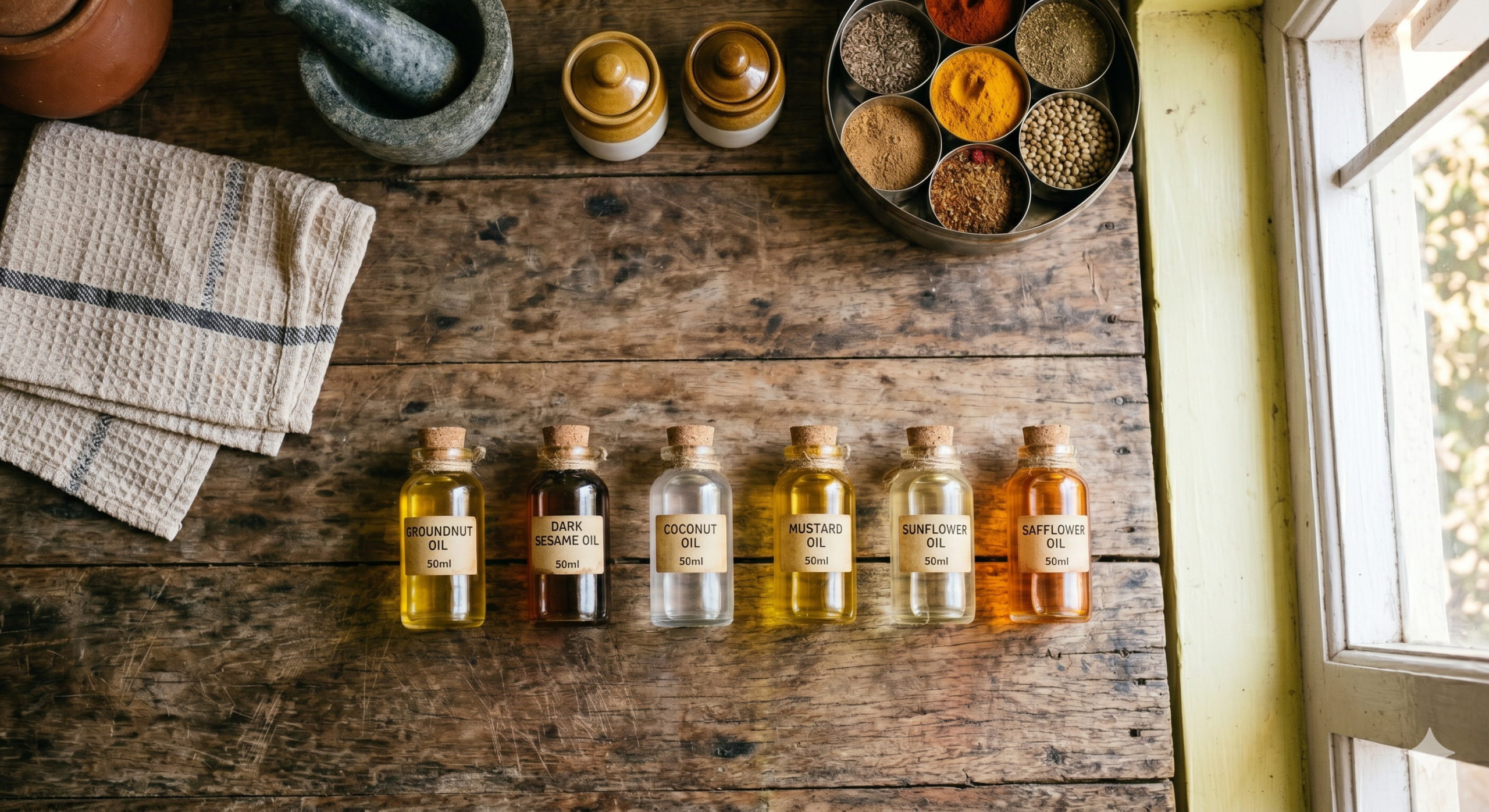
Wood Pressed Oil Comparison Table: At a Glance
| Oil | Smoke Point | Best For | Flavour | Key Benefit |
|---|---|---|---|---|
| Groundnut | ~190°C | Deep frying, tadka, everyday cooking | Nutty, rich | Heart-healthy MUFA |
| Sesame (Gingelly) | ~177°C | South Indian dishes, tadka, rice | Strong, earthy | Antioxidant-rich |
| Coconut | ~175°C | Kerala curries, baking, stir-fry | Sweet, tropical | Medium-chain fats, immunity |
| Mustard (Kachi Ghani) | ~250°C | North Indian cooking, pickles, fish | Pungent, sharp | Antibacterial, high MUFA |
| Sunflower | ~210°C | Light frying, everyday use | Neutral, mild | High Vitamin E |
| Safflower | ~210°C | Diet-conscious cooking, salads | Neutral | High linoleic acid |
“According to FSSAI guidelines, edible oils sold in India must carry a valid licence number — always check before buying.”
The Best Wood Pressed Oils for Cooking: A Detailed Look
1. Wood Pressed Groundnut Oil — Best All-Rounder for Indian Cooking
If you are looking for one oil that does everything, groundnut oil is your answer. It has a high smoke point, which means it does not break down or smoke when you deep fry samosas or make a robust curry. It is rich in monounsaturated fats (MUFA) — the heart-friendly fats — and has a pleasant nutty flavour that enhances food without overpowering it.
South Indian households have used wood pressed groundnut oil (chekku ennai) for generations. It is equally at home for tempering dal, shallow-frying fish, or drizzling over salads.
- Best for: Everyday Indian cooking, deep frying, tadka, stir-frying
- Avoid for: Those with peanut allergies
- Srikruti pick: Wood Pressed Groundnut Oil — 100% kachi ghani extraction, unrefined
2. Wood Pressed Sesame Oil — The South Indian Kitchen Essential
Known as gingelly oil or til oil, wood pressed sesame oil is one of the most nutritionally dense cooking oils available. It contains sesamin and sesamol — rare antioxidants that reduce inflammation and protect the heart. It is also a good source of calcium, zinc, and Vitamin E.
The strong, distinctive flavour of wood pressed sesame oil comes from the natural compounds preserved during cold pressing. A small amount is enough to transform a dish. It is also widely used for oil pulling, hair massage, and skincare.
- Best for: South Indian tadka, rice seasoning, traditional sweets, small stir-fries
- Note: The deep flavour is not for everyone — start with small quantities
Srikruti pick: Wood Pressed Sesame Oil — slow-pressed, full flavour retained
3. Wood Pressed Coconut Oil — Best for Coastal and Kerala Cooking
Wood pressed coconut oil contains medium-chain triglycerides (MCTs) — a type of fat the body converts quickly into energy rather than storing as fat. It is inherently antimicrobial, thanks to lauric acid, and has been shown to support thyroid health and immunity.
The flavour is distinctly coconut — which makes it perfect for Kerala-style curries, appams, fish dishes, and South Indian breakfast items. It is also becoming popular among fitness enthusiasts who add it to coffee or use it in baking.
- Best for: Kerala cuisine, coastal fish curries, chutneys, baking
- Note: Solid at room temperature below 24°C — this is normal and indicates purity
- Srikruti pick: Wood Cold Pressed Coconut Oil — naturally fragrant, no added chemicals
4. Kachi Ghani Mustard Oil — The North Indian Kitchen Staple
Mustard oil has the highest smoke point of all traditional Indian oils — around 250°C — making it ideal for high-heat cooking. Kachi ghani mustard oil has been used in North Indian, Bengali, and Rajasthani kitchens for centuries for a reason: it preserves food (especially pickles), adds a characteristic sharpness to dishes, and is naturally antibacterial.
It is rich in allyl isothiocyanate — the compound responsible for its pungent flavour — and contains a healthy balance of MUFA, PUFA, and omega-3 fatty acids.
- Best for: Pickles, fish dishes, North Indian curries, parathas, marinades
- Note: Strong flavour — use less if you are new to mustard oil cooking
- Srikruti pick: Wood Pressed Mustard Oil — full-pungency kachi ghani extraction
5. Wood Pressed Sunflower Oil — Best Neutral Oil for Daily Use
If you prefer a light, flavour-neutral oil for everyday cooking, wood pressed sunflower oil is the answer. It has one of the highest Vitamin E contents among cooking oils and a high smoke point, making it versatile — suitable for baking, frying, sautéing, and salad dressings.
Unlike refined sunflower oil, the wood pressed version retains all its natural Vitamin E and antioxidants. It is also the best choice for households where the whole family eats together and you need an oil that will not alter the taste of dishes.
- Best for: Family cooking, baking, mild sabzis, children’s food
- Srikruti pick: Wood Pressed Sunflower Oil — cold pressed, retains full Vitamin E
6. Cold Pressed Safflower Oil — Best for the Health-Conscious Cook
Safflower oil (kardai tel) is relatively unknown in most Indian households — but it deserves more attention. It is one of the highest natural sources of linoleic acid (omega-6), supports healthy cholesterol levels, and has a neutral flavour that does not interfere with the dish.
It is especially well-suited for those on a heart-healthy diet, or for cooking light meals and salads. The cold pressed version from Srikruti Naturals retains the full fatty acid profile that makes safflower oil beneficial.
- Best for: Salads, light stir-fries, diet meals
- Srikruti pick: Cold Pressed Safflower Oil — heart-healthy, neutral flavour
How to Choose the Right Wood Pressed Oil for Your Kitchen
“When picking the best wood pressed oil for cooking in India, the decision comes down to your cuisine, smoke point, and health goals.”
Rather than picking just one oil, most nutritionists recommend rotating two or three oils. Here is a simple guide based on cooking style:
- South Indian household: Groundnut + Sesame + Coconut
- North Indian household: Mustard + Sunflower
- Mixed / urban household: Groundnut + Coconut + Sunflower
- Diet / weight management: Safflower + Coconut
- Traditional Ayurvedic kitchen: Sesame + Coconut + Mustard
What to Look for When Buying Wood Pressed Oil in India
Not all oils labelled ‘cold pressed’ or ‘wood pressed’ are equal. Here is what to check:
- Extraction method mentioned: Look for ‘wood pressed’, ‘kachi ghani’, or ‘chekku’ explicitly on the label
- FSSAI certification: Mandatory for all food products sold in India
- No additives or preservatives: Pure wood pressed oil needs nothing added
- Dark bottle or tin packaging: Light degrades natural oils — avoid clear plastic bottles
- Smell and colour: Should smell like the actual ingredient (nutty, earthy, or sharp) — not neutral or processed
Frequently Asked Questions
Which wood pressed oil is best for heart health?
Groundnut oil and mustard oil are both excellent for heart health — they are rich in MUFA which reduces LDL cholesterol. Sesame oil’s antioxidants (sesamin, sesamol) also actively support cardiovascular health.
Can I use wood pressed oil for deep frying?
Yes. Groundnut oil and mustard oil are ideal for deep frying due to their high smoke points. Sesame and coconut oil are better for low to medium heat cooking.
Is wood pressed oil the same as cold pressed oil?
Essentially yes — both refer to mechanical extraction without heat or chemical solvents. ‘Wood pressed’ specifically refers to the traditional wooden ghani (press), while ‘cold pressed’ is the broader international term for the same process.
Which is healthier — filtered groundnut oil or wood pressed groundnut oil?
Wood pressed is healthier. Filtered oils go through a light filtering step, but may still involve some heat. Wood pressed is the purest form — zero heat, zero chemicals, maximum nutrients retained.
The Bottom Line
There is no single best wood pressed oil for cooking — the right choice depends on your cuisine, your health goals, and your family’s taste. What you can be confident about is this: any wood pressed oil from Srikruti Naturals is extracted the right way — no heat, no chemicals, no compromise.
Start with groundnut if you want a safe, versatile first choice. Add sesame or coconut as your second oil. And if you cook North Indian food regularly, a bottle of kachi ghani mustard oil belongs in your kitchen.
Browse all Srikruti Naturals wood pressed and cold pressed oils at srikrutinaturals.com — pure, traditional, and trusted.