Wood pressed oil vs refined oil — which one should your family be cooking with in 2026? Furthermore, this question is now driving one of the biggest shifts in Indian kitchen habits in a generation. Therefore, in this complete guide, we break down every difference so you can make the right choice for your health. At Srikruti Naturals, Hyderabad, we produce 100% wood pressed, cold pressed oils using a traditional wooden ghani — zero chemicals, zero heat, zero shortcuts. Consequently, we know this subject inside and out.
In this complete guide, we compare wood pressed vs refined oil across every factor that matters — nutrients, chemicals, taste, smoke point, and long-term health impact.
What Is Wood Pressed Oil?
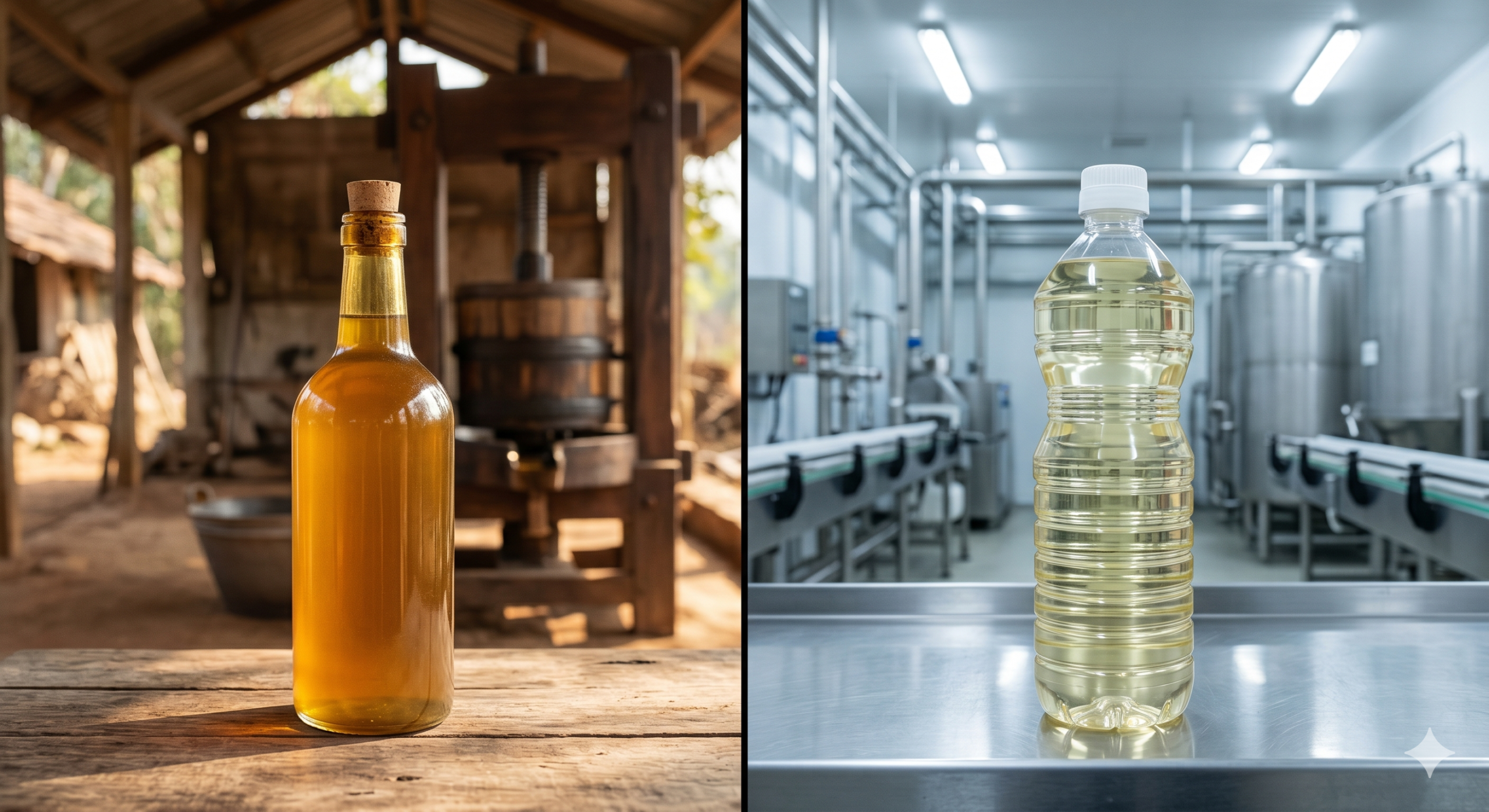
Wood pressed oil comes from crushing oilseeds in a traditional wooden churner — the ghani or kolhu. This ancient method uses no external heat and no chemical solvents. As a result, the oil flows out naturally, retaining its original colour, aroma, nutrients, and fatty acid profile. Furthermore, wood pressed oil is also called cold pressed oil, kachi ghani oil, or ghani oil depending on the region. In South India, people refer to it as chekku oil. However, all these names describe the same traditional, chemical-free extraction process.
What Is Refined Oil?
Refined oil goes through an industrial process involving multiple chemical and heat treatments. Specifically, the refining steps include:
- Solvent extraction using hexane (a petroleum-based chemical)
- Degumming with phosphoric acid
- Neutralisation with sodium hydroxide (caustic soda)
- Bleaching with activated clay to remove natural colour
- Deodorisation at temperatures above 200°C to remove natural smell
As a result of this process, refined oil looks clean, clear, and consistent on a supermarket shelf. However, all the natural nutrients, antioxidants, vitamins, and beneficial fatty acids have been stripped away in the process.

Wood Pressed Oil vs Refined Oil — Complete Comparison
| Feature | Wood Pressed Oil | Refined Oil |
|---|---|---|
| Extraction method | Traditional wooden ghani, low temperature | Chemical solvent + high heat |
| Chemicals used | Zero | Hexane, caustic soda, bleach |
| Nutrients retained | Fully preserved | Largely destroyed |
| Vitamin E | Naturally present | Destroyed in processing |
| Antioxidants | Rich | Stripped out |
| Natural colour | Golden / amber | Pale / colourless |
| Natural aroma | Rich, authentic | Odourless (removed) |
| Chemical residues | None | Possible hexane traces |
| Shelf life | 6–12 months | 18–24 months |
| Smoke point | Medium (varies by oil) | High (heat processed) |
| Best use | Daily cooking, skin, hair | High-heat industrial frying |
| Price | Higher (small-batch) | Lower (mass produced) |
5 Key Differences That Actually Matter for Your Health
1. Nutrients — Wood Pressed Oil Wins Completely
Wood pressed oil retains all its natural Vitamin E, Omega-3, Omega-6, phytosterols, and antioxidants. These compounds protect the heart, reduce inflammation, support brain function, and promote healthy skin and hair. In contrast, refined oil loses the majority of these nutrients during the bleaching and deodorisation process. Therefore, when you cook with refined oil every day, you add processed fat to your food — but almost no nutritional benefit.
2. Chemical Safety — Wood Pressed Is 100% Clean
Wood pressed oil uses zero chemicals at any stage of production. Moreover, refined oil uses hexane — a petroleum solvent — during extraction. Although manufacturers attempt to remove hexane residues through deodorisation, trace amounts may remain in the final product. Additionally, the bleaching and neutralisation steps introduce further chemical agents that have no place in a cooking oil meant for daily family use.
3. Taste and Aroma — No Competition
Wood pressed oils retain the authentic taste and aroma of the original seed. For example, wood pressed groundnut oil carries a rich nutty flavour that enhances South Indian curries, dals, and chutneys in a way that refined oil simply cannot. In contrast, refined oil is deliberately deodorised to create an odourless, tasteless product — losing the very flavour that makes Indian food distinctive and delicious.
4. Smoke Point — The Most Misunderstood Difference
Many people choose refined oil because of its higher smoke point. However, this argument deserves closer examination. Most Indian home cooking — tadka, sautéing, shallow frying — happens between 150°C and 180°C. Wood pressed oils handle this range comfortably. Furthermore, when refined oils reach their high smoke point repeatedly, they produce harmful compounds including aldehydes and trans fats linked to inflammation and cardiovascular disease. Therefore, a wood pressed oil used correctly within its temperature range is actually safer than a high-smoke-point refined oil pushed to its limits.
5. Long-Term Health Impact — The Real Bottom Line
With rising heart disease and obesity cases from 2025, 2026 focuses on better habits — and health-conscious Indians are choosing cold-pressed oils. Furthermore, the growth in demand is primarily driven by the “return to roots” trend, where younger consumers are rejecting refined oils for traditional wood-pressed ghani oils. Daily consumption of refined oil — stripped of nutrients and potentially carrying chemical traces — compounds its impact over years and decades. In contrast, wood pressed oil delivers natural fats that the body recognises and processes efficiently.
Which Wood Pressed Oils Does Srikruti Naturals Produce?
At Srikruti Naturals, Hyderabad, we produce the following wood pressed cold pressed oils — all extracted using a traditional wooden ghani with zero chemicals:
- Groundnut Oil — rich, nutty, ideal for daily South Indian cooking
- Sesame Oil (Gingelly Oil) — traditional nallenna, perfect for chutneys and pickles
- Coconut Oil — pure kobbari nune for cooking, skin, and hair
- Sunflower Oil — light, neutral, high Vitamin E content
- Mustard Oil — pungent, antimicrobial, ideal for North Indian and pickle recipes
- Flax Seed Oil — highest plant-based Omega-3 source, use raw
- Castor Oil — Ayurvedic multipurpose oil for hair, skin, and joints
- Niger Seed Oil — rare Ramtil oil, rich in Vitamin K and Omega-3
- Safflower Oil — heart-friendly, high linoleic acid, ideal for diabetics
Start with our bestseller — wood pressed groundnut oil — ideal for everyday South Indian cooking.
How to Make the Switch from Refined to Wood Pressed Oil
Switching to wood pressed oil does not require a dramatic lifestyle change. Therefore, follow these simple steps:
- Start with one oil: Replace your current cooking oil with wood pressed groundnut or sunflower oil for everyday cooking
- Use the right temperature: Wood pressed oils work best at low to medium heat — ideal for tadka, sautéing, and stir frying
- Store correctly: Keep in a cool, dark place away from sunlight — shelf life is 6–12 months
- Measure your portions: Follow ICMR guidelines of 20ml per adult per day
- Try raw too: Drizzle cold pressed flax seed oil or sesame oil over cooked food for a nutrient boost without heat
Why Choose Srikruti Naturals Wood Pressed Oils?
- Traditional wooden ghani extraction — slow, low-temperature pressing
- Zero chemicals — no hexane, no bleach, no preservatives, no additives
- MSME Government of India approved producer
- Gravity filtered only — nothing added, nothing removed
- Made fresh to order — not pre-stocked or aged on shelves
- 9 oils available — complete range for every cooking need
- Multiple sizes — 100ml to 5 Litres
According to ICMR nutritional guidelines, adults should consume no more than 20ml of cooking oil per day for optimal health.
📞 Call or WhatsApp: 9912770600 🛒 Order online: srikrutinaturals.com/store Starting from ₹70 — 100ml · 250ml · 500ml · 1 Litre · 5 Litre
Frequently Asked Questions
Is wood pressed oil the same as cold pressed oil? Yes — both terms describe the same traditional extraction method. Moreover, the wooden ghani operates at low speeds, generating minimal heat. As a result, people also call it cold pressed oil, kachi ghani oil, or chekku oil depending on the region.
Can I use wood pressed oil for deep frying? You can use wood pressed groundnut oil and coconut oil for moderate deep frying. However, avoid using flax seed oil or castor oil for any cooking — these oils have low smoke points and are best used raw or at very low heat.
Is wood pressed oil worth the higher price? Yes. Furthermore, the price difference per meal is typically ₹3–5. In contrast, refined oil may be cheaper per litre but delivers almost no nutritional benefit. Therefore, wood pressed oil offers genuine value — better taste, better nutrition, and better long-term health outcomes.
How long does wood pressed oil last? Shelf life varies by oil type — typically 6–12 months. Additionally, store in a cool, dark place away from direct sunlight. Refrigerate after opening for oils like flax seed and castor oil.
Does Srikruti Naturals deliver wood pressed oils in Hyderabad? Yes. Srikruti Naturals delivers across Hyderabad and Secunderabad. Moreover, we deliver to nearby areas on request. Therefore, call or WhatsApp 9912770600 to place your order and confirm delivery to your location.