
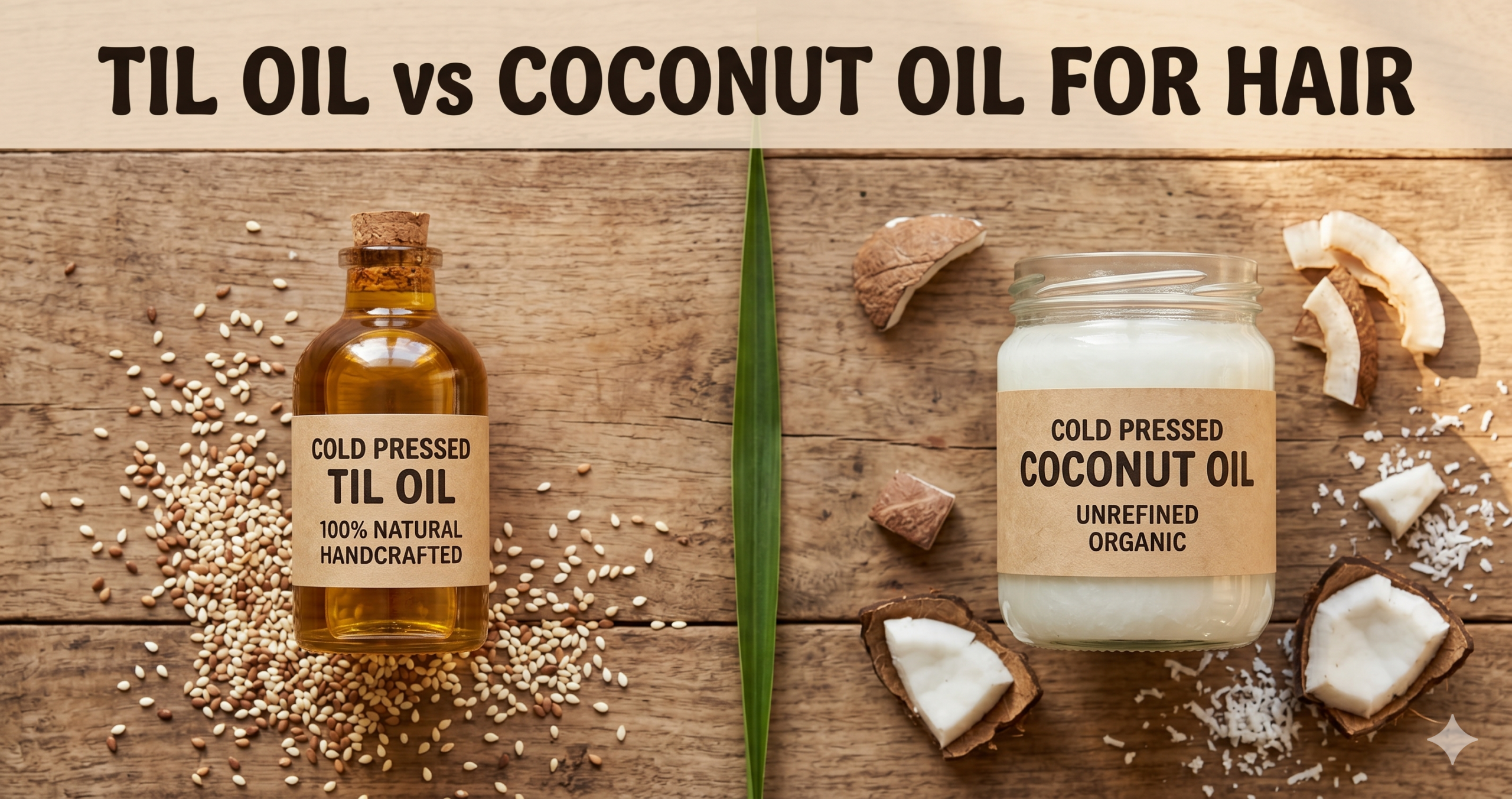
If you have been searching for the best oil for your hair and wondering whether til oil vs coconut oil for hair is the right comparison to make, you are not alone.
The answer to the til oil vs coconut oil for hair debate is not as simple as one being better than the other. The right choice depends on your hair type, your primary concern — whether that is hair fall, dandruff, dryness, or slow growth — and how you use it.
This guide breaks down exactly how til oil and coconut oil compare for hair — what each one does best, which hair types benefit most, and how to choose between them or use both together for the best results.
Both til oil and coconut oil are among the most researched traditional hair oils in India. The key difference is not quality — it is function. Til oil works primarily at the scalp and follicle level. Coconut oil works at the hair shaft level.
Til Oil vs Coconut Oil for Hair: The Quick Answer
For hair growth and scalp health: til oil (sesame oil) is generally the better choice. It penetrates the scalp deeply, stimulates hair follicles, fights dandruff, and has been used in Ayurvedic head massage for thousands of years.
For dry, damaged, or highly porous hair: cold pressed coconut oil wins. Its high lauric acid content allows it to penetrate the hair shaft and significantly reduce protein loss, making it the best oil for conditioning and repairing damaged hair.
Choose Til Oil if you have:
- Hair fall or thinning hair
- Dandruff or itchy, irritated scalp
- Oily scalp with normal to fine hair
- Premature greying
- Slow hair growth
Choose Coconut Oil if you have:
- Dry, frizzy, or coarse hair
- Chemically treated or coloured hair
- High porosity hair that loses protein easily
- Split ends and excessive breakage
- Very dry scalp needing intense moisture
What Is Cold Pressed Til Oil and Why Is It Good for Hair?
Til oil — also known as sesame oil or gingelly oil — is extracted from sesame seeds (Sesamum indicum) by cold pressing without heat or chemicals. Cold pressed til oil retains all its natural nutrients, including sesamol, sesamin, sesamolin, Vitamin E, Vitamin B complex, zinc, magnesium, calcium, and linoleic acid.
In Ayurveda, til oil is considered one of the most effective oils for Abhyanga (full body oil massage) and Shirodhara (head oil therapy). It is classified as warming, deeply nourishing, and particularly beneficial for Vata-type conditions — which include hair fall, dryness, and slow growth.
Key Benefits of Til Oil for Hair:
- Stimulates hair follicles — sesamol increases scalp circulation and promotes new hair growth
- Fights dandruff — natural antifungal properties target the fungus responsible for dandruff
- Reduces hair fall — strengthens hair roots and reduces breakage from the follicle
- Delays premature greying — high copper and zinc content supports melanin production
- UV protection — sesame oil has a natural SPF of approximately 4, protecting hair from sun damage
- Conditions without heaviness — lighter than coconut oil, absorbs without leaving excessive residue
Read more about the full range of cold pressed sesame oil benefits for skin, hair, and cooking.
What Is Cold Pressed Coconut Oil and Why Is It Good for Hair?
Cold pressed coconut oil is extracted from fresh or dried coconut kernels using mechanical pressing at low temperatures. It retains its natural lauric acid (approximately 47-49%), caprylic acid, Vitamin K, Vitamin E, and polyphenols — all of which are lost in refined coconut oil.
Coconut oil is unique among hair oils because of its molecular structure. The lauric acid in coconut oil has a low molecular weight and straight chain structure that allows it to penetrate the hair shaft — not just coat the surface — which is why it is so effective at reducing protein loss.
Key Benefits of Coconut Oil for Hair:
- Reduces protein loss — lauric acid penetrates the hair shaft and binds to hair proteins, preventing damage
- Deep conditioning — intensely moisturises dry, brittle, or chemically treated hair
- Reduces frizz — seals the hair cuticle, controlling humidity-related frizz
- Antimicrobial — lauric acid has natural antibacterial properties that keep the scalp healthy
- Prevents breakage — by filling gaps in the hair shaft, coconut oil reduces mechanical damage from brushing and styling
- Shine and softness — gives hair a healthy lustre without synthetic coating
Studies show that research on coconut oil and hair protein loss confirms that coconut oil significantly reduces protein loss in both damaged and undamaged hair compared to mineral oil and sunflower oil.
Explore the full benefits of cold pressed coconut oil for hair, skin, and cooking.
Til Oil vs Coconut Oil for Hair: Full Comparison Table
| Property | Cold Pressed Til Oil | Cold Pressed Coconut Oil |
| Best for hair type | Oily scalp, fine hair, normal hair | Dry, brittle, coarse, porous hair |
| Primary benefit | Scalp health, hair growth, anti-dandruff | Deep conditioning, protein protection |
| Key nutrients | Sesamol, sesamin, Vitamin E, zinc | Lauric acid, MCTs, Vitamin K |
| Scalp penetration | Deep — reaches hair follicles | Very deep — penetrates hair shaft |
| For hair growth | Excellent — stimulates follicles | Good — prevents protein loss |
| For dandruff | Excellent — antifungal properties | Good — antimicrobial lauric acid |
| For dry scalp | Good — moisturising | Excellent — intense hydration |
| For hair fall | Excellent — strengthens roots | Good — reduces breakage |
| Smell | Mild, nutty, earthy | Sweet, light coconut fragrance |
| Texture | Medium — absorbs well | Rich — heavier feel |
| Best season use | All seasons, especially winter | Summer, monsoon |
| Washing out | Easy with one shampoo | May need two washes |
| Ayurvedic use | Abhyanga, Shirodhara | Nasya, hair oiling |
| Srikruti product | Wood Cold Pressed Til Oil | Cold Pressed Coconut Oil |
Which Oil Should You Choose? Hair Type Guide
| Your Hair Concern | Recommended Oil |
| Hair fall / thinning | Til Oil — strengthens roots and follicles |
| Dry, frizzy, coarse hair | Coconut Oil — deep moisture and protein protection |
| Dandruff / itchy scalp | Til Oil — antifungal sesamol targets dandruff |
| Damaged, chemically treated hair | Coconut Oil — lauric acid repairs protein loss |
| Premature greying | Til Oil — traditional remedy, rich in copper and zinc |
| Oily scalp | Til Oil — lighter texture, balances sebum |
| Split ends | Coconut Oil — seals cuticle, reduces breakage |
| Slow hair growth | Til Oil — increases scalp circulation |
| Normal hair maintenance | Either — alternate weekly for best results |
How to Use Til Oil and Coconut Oil for Best Hair Results
How to Use Cold Pressed Til Oil for Hair:
- Warm 2-3 tablespoons of til oil slightly (do not overheat)
- Part your hair and apply directly to the scalp using fingertips
- Massage in circular motions for 5-10 minutes to stimulate circulation
- Leave for a minimum of 1 hour — overnight gives best results
- Wash with a mild shampoo — one wash is typically enough
- Use 2-3 times per week for hair fall; once a week for maintenance
How to Use Cold Pressed Coconut Oil for Hair:
- Take 1-2 tablespoons of coconut oil (melt if solid by warming the jar)
- Apply from mid-lengths to ends for dry hair — or to scalp for dry scalp
- Gently work through hair ensuring full coverage on dry or damaged sections
- Leave for 30 minutes minimum — for deep conditioning, overnight under a shower cap
- Shampoo thoroughly — may need two washes to remove completely
- Use once or twice a week depending on your hair’s dryness levelPro tip: Combine both oils for maximum benefit. Apply til oil first to your scalp and massage well, then apply coconut oil from mid-lengths to ends. You get scalp stimulation + hair shaft protection in a single oiling session.
Frequently Asked Questions
Is cold-pressed coconut oil better than sesame oil for hair?
Neither is universally better — they serve different purposes. Cold pressed coconut oil is better for dry, damaged hair because its lauric acid penetrates the hair shaft and reduces protein loss. Cold pressed til oil (sesame oil) is better for scalp health, hair growth, and dandruff because it penetrates the scalp deeply and stimulates follicles.
Which oil is best for hair, til or coconut?
For hair growth and dandruff: til oil wins. For dry, coarse, or chemically treated hair: coconut oil wins. For best overall results, use til oil on your scalp and coconut oil on your hair lengths and ends — you get the benefits of both in a single hair oiling routine.
Can I mix til oil and coconut oil for hair?
Yes — mixing til oil and coconut oil is one of the most effective traditional combinations for hair care in India. A 50:50 mix combines the follicle-stimulating properties of sesame oil with the deep conditioning of coconut oil. Apply to the scalp and lengths, leave overnight, and wash the next morning.
How often should I use til oil on my hair?
For hair fall or active dandruff, use cold pressed til oil 2-3 times per week. For general maintenance and scalp health, once a week is sufficient. Always massage into the scalp for 5-10 minutes to activate its follicle-stimulating benefits.
Does til oil darken hair?
Traditional usage suggests that regular application of sesame oil (til oil) may help delay premature greying and maintain hair’s natural colour. This is attributed to its copper and zinc content, which supports melanin production. However, it will not artificially darken hair that has already turned grey.
Which is the best oil for hair growth in India?
Cold pressed til oil, coconut oil, and castor oil are the three most effective traditional Indian oils for hair growth, each working through different mechanisms. For a complete comparison, read our guide on the best oil for hair growth in India.
Summary: Til Oil vs Coconut Oil for Hair
The til oil vs coconut oil for hair debate does not have a single winner — it has two specialists. Cold pressed til oil is the specialist for scalp health, hair growth, dandruff, and follicle stimulation. Cold pressed coconut oil is the specialist for hair shaft conditioning, protein protection, and repairing dry or damaged hair.
The most effective approach for most hair types is to use both: til oil on the scalp, coconut oil on the lengths and ends. Together, they address hair care from root to tip — which is exactly what traditional Indian hair oiling has always done.
Srikruti Naturals Cold Pressed Til Oil and Cold Pressed Coconut Oil are both wood-pressed with zero chemicals, zero heat, and zero compromise on nutrients. Pure as nature intended.