
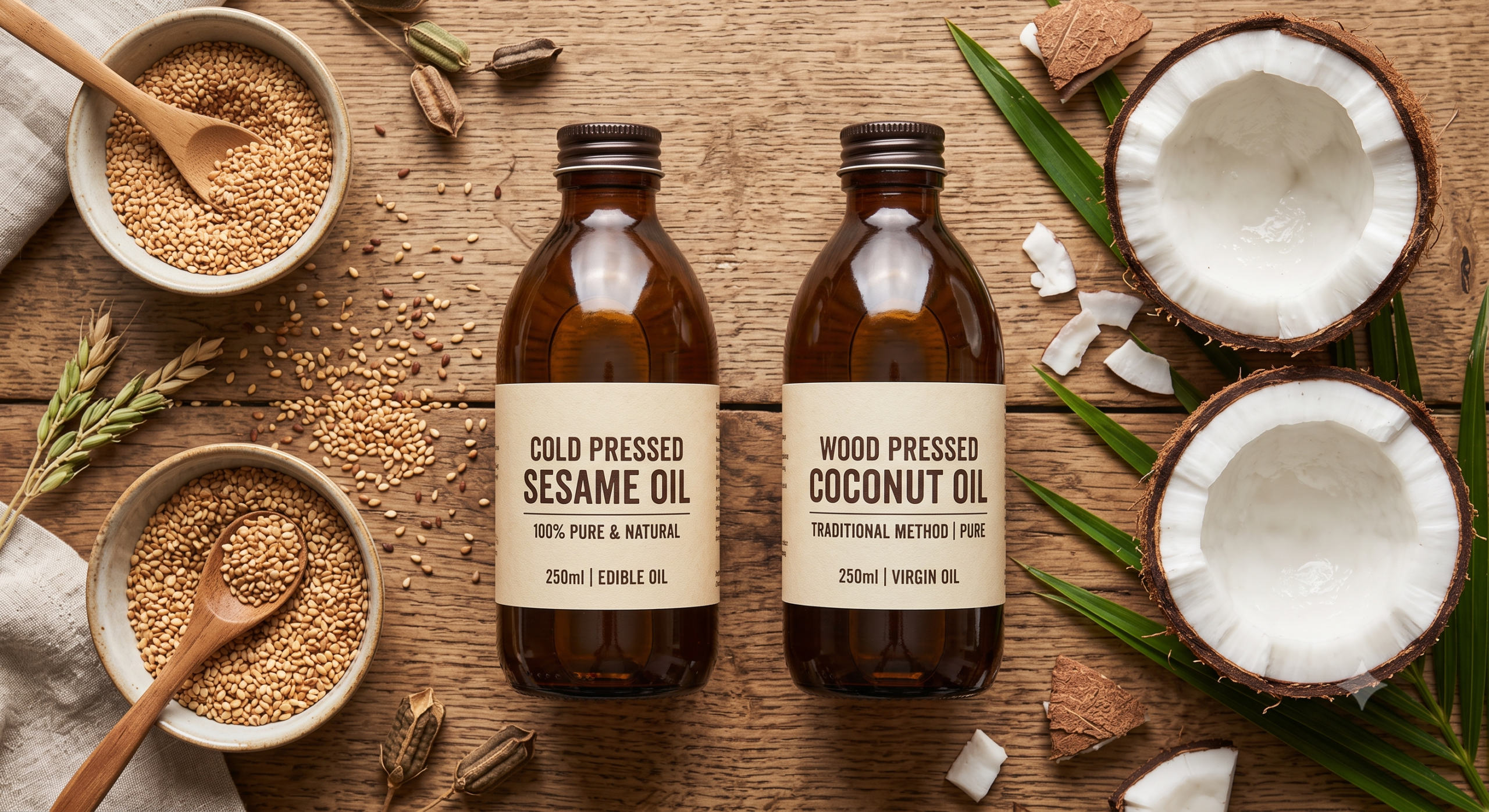
Cold Pressed Oil vs Coconut Oil: What Actually Differs
Cold pressed is an extraction method. Coconut oil is a specific type of oil. They are not the same thing. Cold pressed coconut oil means coconut oil made using the cold press method — so it is both at once. When people ask about cold pressed oil vs coconut oil, they are usually comparing cold pressed coconut oil against other cold pressed oils like sesame, groundnut, castor, or mustard. That is the comparison worth making — and the differences are significant.
Why Cold Pressed vs Coconut Oil Confuses Everyone
Both terms appear on similar-looking amber glass bottles. Both are marketed as natural, traditional, and chemical-free. Health food stores often place them side by side. And because coconut oil has been the dominant wellness oil for the past decade, many people assume cold pressed automatically means coconut. It does not. Cold pressing is just the extraction process — the same way stone-ground means how flour is milled, not what grain it came from.
Quick Comparison Table
| Aspect | Cold Pressed Oil (general) | Cold Pressed Coconut Oil |
| What it is | A method of extraction — any seed can be cold pressed | One specific oil extracted by the cold press method |
| Examples | Sesame, groundnut, castor, mustard, flax, niger seed | Only coconut oil — from fresh or dried coconut |
| Fatty acid type | Varies — sesame has MUFA, flax has omega-3, castor has ricinoleic acid | High in saturated fat (lauric acid, MCTs) |
| Best for cooking | Depends on oil — groundnut and sesame handle heat well | Medium heat cooking, baking, breakfast items |
| Best for hair | Castor (growth), sesame (scalp health) | Pre-wash protein protection, scalp moisture |
| Best for skin | Sesame (anti-ageing), castor (deep moisturising) | Light daily moisturiser, gentle enough for babies |
| Smoke point | Varies — groundnut 160°C, sesame 175°C, mustard 250°C | Around 175°C — higher for refined versions |
| Shelf life | 6 to 12 months — store away from sunlight | 18 to 24 months — stable due to high saturated fat |
| Price range India | Varies — flax and castor costlier, groundnut affordable | Mid-range — wood pressed coconut slightly premium |
What Cold Pressed Coconut Oil Actually Is
Cold pressed or wood pressed coconut oil is made by pressing fresh coconut meat at low temperature without heat or chemical solvents. This preserves lauric acid, caprylic acid, and medium-chain triglycerides (MCTs) that refined coconut oil loses during deodorising and bleaching. A study on lauric acid’s antimicrobial properties confirms why wood pressed coconut oil has been trusted in traditional Indian medicine. Refined coconut oil looks and smells neutral — which is the giveaway. Real cold pressed coconut oil smells exactly like fresh coconut.
What Other Cold Pressed Oils Bring That Coconut Cannot
Each cold pressed oil has a unique fatty acid profile that coconut oil simply does not share. Cold pressed sesame oil contains sesamol and sesamin — antioxidants with proven anti-inflammatory activity. Cold pressed flax seed oil is the richest plant source of ALA omega-3 fatty acids, essential for heart health and brain function. Cold pressed castor oil has ricinoleic acid, used specifically for scalp circulation and joint pain. Cold pressed mustard oil has allyl isothiocyanate, which supports cardiovascular health and scalp blood flow. None of these overlap with coconut oil’s MCT-dominant profile.
Which Is Better for Cooking
Neither is universally better — they suit different situations
Use cold pressed coconut oil when:
- Cooking at medium heat — upma, poha, dosas, eggs, shallow frying.
- Cooking for toddlers and young children — gentlest on small stomachs.
- Making sweets or baked items where coconut flavour works naturally.
- You want a light, neutral oil that does not dominate the dish’s flavour.
Use other cold pressed oils when:
- Cooking at high heat — cold pressed mustard oil handles up to 250°C.
- You want deeper flavour in dal and tempering — cold pressed sesame or groundnut.
- You need omega-3 support — add cold pressed flax seed oil raw to curd or salad.
- Daily cooking for the whole family — cold pressed groundnut oil is the most versatile.
Which Is Better for Hair
- Coconut oil — best as pre-wash treatment. Reduces protein loss from wet hair. Apply 30 minutes before shampooing.
- Castor oil — best for scalp circulation and follicle strength. Mix with sesame in 1:2 ratio for easier spread.
- Sesame oil — penetrates the hair shaft more deeply than coconut. Better for reducing strand-level protein loss.
- Coconut oil also has mild antifungal properties from lauric acid — useful for monsoon scalp fungus.
Which Is Better for Skin
- Coconut oil — lighter, absorbs faster, better for daily face and body moisturising in humid weather.
- Sesame oil — better for anti-ageing and deep nourishment, more antioxidant activity.
- Castor oil — best for dry patches and cracked heels, too heavy for regular face use.
- For babies — cold pressed coconut oil is the gentlest and most widely recommended option.
The Real Decision — Cold Pressed Oil vs Coconut Oil
Whether you pick coconut, sesame, or groundnut oil — the more important choice is always cold pressed vs refined. Refined versions of every oil lose nutrients, antioxidants, and active compounds during high-heat chemical processing. Cold pressed vs refined oil is a bigger quality gap than coconut vs sesame. Pick whichever oil suits your cooking — then make sure it says cold pressed or wood pressed on the label.
Conclusion
Cold pressed is the process. Coconut oil is the product. Cold pressed oil vs coconut oil is not an either/or choice — it is about knowing when each one fits. Use wood pressed coconut oil for medium-heat cooking and children. Use cold pressed sesame or groundnut for everyday tempering and curries. Use cold pressed flax or mustard for specific health goals. They are not competing — they are complementary. Browse Srikruti Naturals’ full range of cold pressed and wood pressed oils to find the right oil for each job in your kitchen.
FREQUENTLY ASKED QUESTIONS
Q: Is cold pressed oil and coconut oil the same thing?
No. Cold pressed is an extraction method — it describes how oil is made. Coconut oil is a specific type of oil — it describes what the oil is made from. Cold pressed coconut oil is coconut oil made using the cold press method, so it is both at once. But cold pressed sesame oil, groundnut oil, or castor oil are completely different oils.
Q: Which is better for Indian cooking — cold pressed coconut oil or other cold pressed oils?
For medium heat cooking and breakfast items, cold pressed coconut oil works well. For high-heat cooking like deep frying or heavy curries, cold pressed mustard or groundnut oil handles heat better. Cold pressed sesame oil is ideal for dal and rasam tempering in South Indian cooking.
Q: Can I use cold pressed coconut oil for hair fall?
Cold pressed coconut oil helps reduce protein loss from wet hair and has mild antifungal properties useful for monsoon scalp issues. But for hair fall specifically, cold pressed castor oil for scalp circulation and cold pressed sesame oil for follicle nourishment are more directly effective.
Q: What is the difference between wood pressed and cold pressed coconut oil?
Both terms mean the oil was extracted without heat. Wood pressed specifically refers to the traditional ghani or chekku method using a wooden press. Cold pressed is the broader term. Both are superior to refined coconut oil. Srikruti Naturals uses the traditional wood press method.
Q: Is cold pressed coconut oil good for babies?
Yes. Cold pressed coconut oil is one of the gentlest oils for babies — easy to digest, mild in flavour, and with natural antimicrobial properties from lauric acid. It is commonly used for baby cooking and massage. Always check with your paediatrician before introducing any new oil for infants under 6 months.
Q: Which cold pressed oil has the most omega-3?
Cold pressed flax seed oil has the highest plant-based omega-3 content of any cold pressed oil. Cold pressed mustard oil also has a good omega-3 to omega-6 ratio. Coconut oil has very little omega-3 — it is dominated by saturated medium-chain fatty acids instead.