
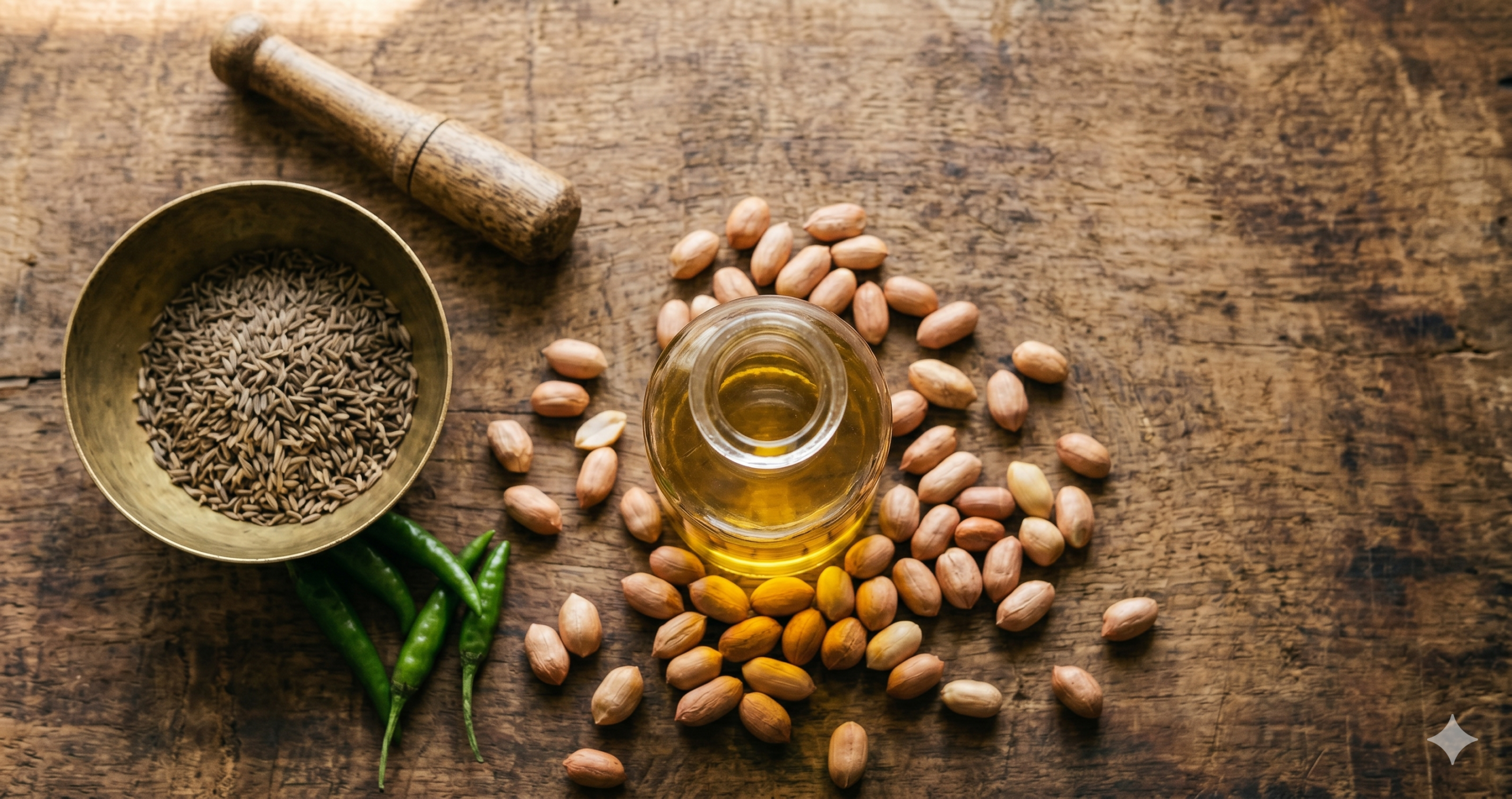
Cold pressed groundnut oil for cooking is quietly reclaiming its place in Indian kitchens — and for very good reason. You probably grew up watching your grandmother cook in golden-coloured oil with a rich nutty aroma. That was almost certainly kachi ghani groundnut oil, not the pale, odourless refined version most households use today.
So, what exactly is the difference? Furthermore, does the switch actually matter for your health? In this guide, you will find honest answers to both questions.
What Is Cold Pressed Groundnut Oil & How Is It Made?
Specifically, cold pressed groundnut oil — also called kachi ghani or wood pressed groundnut oil — is extracted from raw peanuts using a mechanical press at temperatures below 49°C. In other words, manufacturers use no heat, no chemical solvents, and no bleaching agents during extraction.
As a result, the oil retains its natural golden colour, nutty aroma, vitamin E, and the full fatty acid profile that makes groundnut oil one of the healthiest traditional cooking fats in India.
Wood Pressed vs Cold Pressed — Is There a Difference?
This is a common question. On one hand, wood pressed groundnut oil uses a traditional wooden Kolhu (also called Chekku or Ghani) driven by bullocks or motors — a slow, low-heat pressing method. On the other hand, cold pressed oil uses modern mechanical expellers with strict temperature control. Both methods are chemical-free and preserve nutrients effectively. Therefore, the terms are often used interchangeably in the Indian market.
What Is Refined Groundnut Oil? (And Why Is It Different?)
Refined groundnut oil starts with raw peanuts but goes through a very different journey. First, manufacturers extract the oil at high heat or using hexane solvents. Then, they bleach it to remove colour and subject it to chemical deodorisation to remove the natural aroma.
Although this process produces a longer shelf life and a neutral taste, it strips out most of the antioxidants, vitamin E, and resveratrol that make groundnut oil nutritionally valuable. Furthermore, the high-heat refining process can create small amounts of trans fats — something cold pressed oil never contains.
💡 The term ‘kachi ghani’ has no legal protection in India. However, reputable brands like Srikruti Naturals clearly state ‘cold pressed’ and ‘chemical-free’ on their labels. Always check before buying.
Cold Pressed vs Refined — Full Comparison
Here is a side-by-side breakdown so you can see exactly what you are choosing between:
| Feature | Cold Pressed Groundnut Oil ✅ | Refined Groundnut Oil |
|---|---|---|
| Extraction | Cold pressed below 49°C — no chemicals | High heat + hexane solvents |
| Smoke Point | ~160°C (medium heat ideal) | ~232°C (high heat frying) |
| Colour | Golden yellow, natural | Pale yellow to clear |
| Taste & Aroma | Nutty, rich, traditional | Neutral, odourless |
| Nutrients | Vitamin E, Resveratrol, MUFA, PUFA intact | Most nutrients stripped |
| Oleic Acid (MUFA) | ~46–50% (heart healthy) | Present but lower due to processing |
| Linoleic Acid | ~30–33% (Omega-6, intact) | Present but oxidised at high heat |
| Chemicals Used | None | Bleaching + deodorising agents |
| Price (India) | ₹350–₹600 per litre | ₹120–₹250 per litre |
| Shelf Life | 9–12 months | 12–18 months |
Smoke Point of Cold Pressed Groundnut Oil — Is It Safe for Indian Cooking?
This is the most important practical question. Cold pressed groundnut oil has a smoke point of approximately 160°C. Refined groundnut oil, by contrast, reaches 232°C before smoking. So, which one should you use?
What the Smoke Point Actually Means for Your Kitchen
A smoke point is the temperature at which oil starts breaking down and releasing harmful compounds. However, most Indian home cooking — tadka, sautéing, stir frying, and even shallow frying — happens between 120°C and 160°C. Therefore, cold pressed groundnut oil handles these tasks perfectly well.
When to Use Refined Groundnut Oil Instead
Refined groundnut oil has one clear advantage: deep frying at very high temperatures above 180°C — like samosas, pakoras, or puri at sustained full flame. For everything else, cold pressed is the healthier and more nutritious option.
Quick Temperature Guide
Tadka / Tempering ~120–140°C — ✅ Cold Pressed Safe
Stir Fry / Sabzi ~140–160°C — ✅ Cold Pressed Safe
Shallow Frying ~160–170°C — ✅ Cold Pressed Safe (keep flame medium)
Deep Frying ~180–190°C — ⚠️ Use Refined for sustained frying
Cold Pressed Groundnut Oil Benefits for Health
Here is what the nutrition profile of cold pressed groundnut oil actually gives your family:
1. Rich in Monounsaturated Fatty Acids (MUFA)
Cold pressed groundnut oil contains approximately 46–50% oleic acid (MUFA). Moreover, research shows that regular MUFA intake supports healthy cholesterol levels by raising HDL and lowering LDL. In addition, oleic acid supports cardiovascular health in the long term.
2. High Natural Vitamin E Content
Specifically, cold pressed groundnut oil delivers significant amounts of tocopherols — the natural form of vitamin E. These act as antioxidants in your body. However, refined groundnut oil loses most of this vitamin E during bleaching and high-heat processing.
3. Resveratrol — The Anti-Ageing Compound
Resveratrol is present naturally in groundnuts and survives in cold pressed oil. Furthermore, it has been studied for its anti-inflammatory, anti-ageing, and cardiovascular protective properties. Refined oil, by contrast, loses resveratrol entirely during processing.
4. No Trans Fats
Because cold pressed groundnut oil never goes through high-heat processing, it contains zero trans fats. As a result, it is a safer daily cooking fat for families managing heart health, cholesterol, or weight.
These are most valued benefits with our ground nut oil for health
ICMR Nutrition Note
💡 As per ICMR dietary guidelines, groundnut oil is listed as one of the recommended cooking oils for Indian households due to its balanced MUFA and PUFA profile. Cold pressed variants retain these benefits most effectively.
What Can You Cook with Cold Pressed Groundnut Oil?
Here are the everyday Indian cooking uses where cold pressed groundnut oil for cooking performs exceptionally well:
- Tadka and Tempering: Mustard seeds, cumin, dried chillies — the nutty aroma elevates any dal or vegetable sabzi naturally
- South and North Indian Curries: From rajma to sambar — groundnut oil blends seamlessly with spice-forward gravies
- Stir Fries and Dry Sabzi: Medium flame cooking where the rich flavour enhances the dish
- Egg Dishes: Omelettes and fried eggs cooked on medium heat come out richer and more flavourful
- Shallow Frying: Cutlets, tikkis, and parathas — excellent results at medium heat
- Salad Dressings and Marinades: The natural flavour adds depth to chutneys, marinades, and cold preparations
- Baking: Replaces refined oil in healthy Indian sweets, cakes, and energy bars
5 Reasons Cold Pressed Groundnut Oil Beats Refined in 2026
- No chemicals in your food: Zero hexane, zero bleaching agents — consequently, what you cook in is pure, natural oil
- Better taste: The natural nutty aroma enhances Indian dishes in ways refined oil simply cannot replicate
- Full nutrition retained: Vitamin E, resveratrol, and natural fatty acids survive because cold pressing never exceeds 49°C
- No trans fats: High-heat refining creates trans fats — whereas cold pressing eliminates this risk entirely
- Traditional authenticity: The kachi ghani movement is growing across India as consumers return to what their grandparents trusted
How to Identify Real Cold Pressed Groundnut Oil
The Indian edible oil market has a significant greenwashing problem. For example, many refined oil brands now add ‘natural’ or ‘traditional’ to their labels without changing their process. Therefore, look for these specific indicators:
- ✅ ‘Cold pressed’ or ‘kachi ghani’ — explicitly stated, not just implied
- ✅ Golden colour — real cold pressed groundnut oil is naturally golden-yellow, not pale or clear
- ✅ Nutty aroma — open the bottle; you should smell roasted peanuts. Odourless means refined
- ✅ No solvent extraction — hexane-free label is important
- ✅ Short ingredient list — only groundnuts, nothing else
- ✅ FSSAI registration — always verify the brand is FSSAI certified
💡 If the oil is completely odourless and water-clear, it is refined — regardless of what the front label says.
Frequently Asked Questions
Is cold pressed groundnut oil good for daily cooking?
Yes, absolutely. For daily Indian cooking at medium heat — tadka, curries, sabzi, and eggs — groundnut oil is an excellent choice. Moreover, its MUFA content supports heart health when used as part of a balanced diet.
Can You Use It for Deep Frying?
For occasional shallow to medium frying below 170°C, yes. However, for sustained deep frying above 180°C, refined groundnut oil handles the temperature more safely. Therefore, keep both in your kitchen for different purposes.
Does groundnut oil have a strong smell?
Yes — it has a natural, mild roasted peanut aroma. This enhances Indian dishes beautifully. However, if you prefer a neutral flavour for specific recipes, refined oil suits those dishes better.
How Should You Store this oil tin?
Simply store it in a cool, dry place away from direct sunlight. No refrigeration needed. Typically, proper storage keeps it fresh for 9–12 months. Furthermore, always use a clean, dry spoon to avoid contamination.
Is It Safe for People With Peanut Allergies?
No — people with peanut allergies should avoid groundnut oil in all forms, including cold pressed. Always consult your doctor before making dietary changes if you have a known allergy.
Final Verdict: Should You Switch to Cold Pressed Groundnut Oil?
For everyday Indian cooking at home, cold pressed groundnut oil is the clear winner. Specifically, it delivers better nutrition, better taste, and zero chemical residues. Furthermore, its smoke point handles 90% of what happens in a typical Indian kitchen.
Choose refined groundnut oil only when you specifically need sustained high-heat deep frying above 180°C. Otherwise, for your daily tadka, curries, sabzi, and shallow frying — cold pressed is the right choice for your family’s health.
Try Srikruti Naturals Wood Cold Pressed Groundnut Oil — slow-pressed, chemical-free, the way Indian kitchens have always done it.
👉 Shop Srikruti Naturals Cold Pressed Groundnut Oil → srikrutinaturals.com/store