
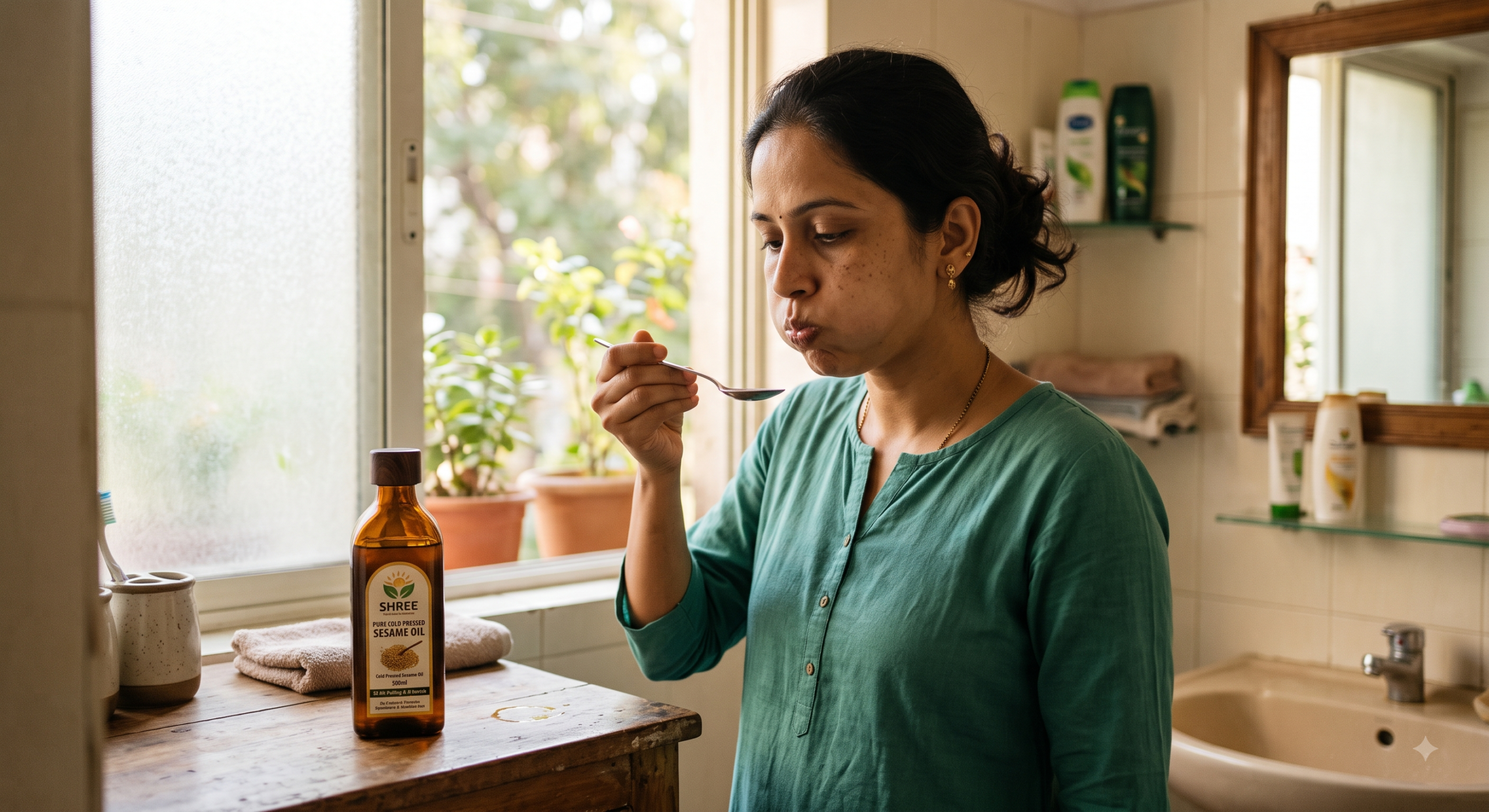
Yes, oil pulling with cold pressed oil works for oral health. A 2025 randomised controlled trial found cold pressed sesame oil significantly reduced dental plaque compared to water. Cold pressed coconut oil showed similar results in a 2023 crossover trial. Oil pulling is one of the oldest Ayurvedic morning practices in India — called gandusha or kavala graha in Sanskrit. The practice involves swishing oil around the mouth for 10 to 20 minutes before eating or drinking anything. For most of its history, cold pressed sesame oil was the standard choice. Today, coconut oil has become equally popular. Oil pulling with cold pressed oil is now backed by more clinical research than most people realise — not as a cure-all, but as a genuine adjunct to oral hygiene that reduces plaque, supports gum health, and freshens breath without the side effects of chemical mouthwashes.
What Does the Research Actually Say
A 2025 randomised controlled trial published on NCBI from the Medical University of Innsbruck compared daily sesame oil pulling against distilled water over eight weeks in 40 participants. Sesame oil pulling reduced full-mouth plaque index by 18.98 percent compared to 10.49 percent for water — a statistically significant difference. Plaque reduction was most pronounced on anterior, buccal, and lingual surfaces, and on approximal surfaces after four weeks.
A 2023 crossover RCT in PubMed compared coconut oil and sesame oil pulling over four days in 24 participants. Both oils showed similar plaque regrowth inhibition — confirming that cold pressed coconut oil is a valid alternative to sesame oil for oil pulling with comparable effectiveness.
A 2024 meta-analysis of 25 trials involving 1,184 participants found that oil pulling clinically and significantly improved gingival health scores when compared to non-chlorhexidine mouthwash. Chlorhexidine (the gold standard chemical mouthwash) was still more effective for plaque reduction, but oil pulling had no side effects — no tooth staining, no taste disturbance, no mucosal irritation.
The honest summary: oil pulling with cold pressed oil is not a replacement for brushing or dental visits. It is a well-evidenced adjunct that adds meaningful oral health benefit with zero downside when done correctly.
How Oil Pulling Works — The Science
Three mechanisms explain why cold-pressed oil reduces oral bacteria and plaque:
- Saponification — oil reacts with alkaline saliva to produce a mild soap-like effect that disrupts the cell membranes of oral bacteria.
- Viscosity — the thick oil physically coats bacterial biofilm on teeth and gum surfaces, preventing adhesion and helping remove it when you spit.
- Active compounds—cold-pressed sesame oil contains sesamin, sesamolin, and sesamol, which have proven antioxidant and antibacterial activity. Cold pressed coconut oil’s lauric acid converts to monolaurin in the mouth, which disrupts bacterial cell walls directly.
Refined oils lack the active compounds that make cold-pressed oils effective for oil pulling. Sesamin and sesamol are destroyed in the refining process. Lauric acid activity is reduced. If you are going to oil pull, it must be cold pressed or wood pressed oil.
Cold Pressed Sesame Oil vs Wood Pressed Coconut Oil — Which to Use
| Factor | Cold Pressed Sesame Oil ✅ | Wood Pressed Coconut Oil ✅ |
| Taste | Mild nutty — most people find it easier to hold | Mild coconut — some find sweetness easier |
| Antibacterial activity | Sesamin, sesamolin — proven antioxidant activity | Lauric acid — antimicrobial against oral bacteria |
| Plaque reduction | 18.98% reduction vs distilled water in 8-week RCT | Similar to sesame in 4-day crossover RCT |
| Gum health | Clinically significant gingival score improvement in meta-analysis | Similar benefit in short-term studies |
| Consistency | Stays liquid — easier to swish in Indian summers | Solidifies below 24°C — may need warming in winter |
| Traditional use | Ancient Ayurvedic oil pulling oil — gandusha in Sanskrit | Gaining popularity, less traditional history |
| Price | Mid-range — comparable | Mid-range — comparable |
| Best for | Sensitive gums, best all-round evidence base | Those who prefer mild flavour, coconut-familiar palate |
Both cold pressed sesame oil and wood pressed coconut oil work. Sesame oil has more clinical trial data behind it and is the traditional Ayurvedic choice. Coconut oil is easier for those who find sesame oil’s flavour too strong. Both are correct choices — use whichever one you can commit to doing consistently, because consistency matters more than which oil you pick.
How to Do Oil Pulling Correctly — Step by Step
- Wake up and do oil pulling before eating, drinking, or brushing. The mouth bacteria population is highest first thing in the morning — that is when it is most effective.
- Take one tablespoon of cold pressed sesame or wood pressed coconut oil. If coconut oil has solidified overnight, let it melt in your mouth for a few seconds before swishing.
- Swish the oil gently around your mouth — between teeth, across gums, under tongue. Do not gargle. The oil should move through the teeth and coat all surfaces.
- Continue for 10 to 20 minutes. The oil will become thinner and slightly white as it mixes with saliva and emulsifies bacteria.
- Spit into a bin or tissue — never the sink. Spitting oil into a drain repeatedly causes blockage over time.
- Rinse your mouth thoroughly with warm water. Then brush your teeth normally.
- Do this daily. Clinical trials ran for 4 to 8 weeks — short-term use shows limited benefit. Consistency is what produces results.
Common Mistakes That Reduce Effectiveness
- Using refined oil instead of cold pressed — the active compounds are gone. Refined coconut or sesame oil will not give the same results.
- Swishing for only 2 to 3 minutes — too short for the saponification and bacterial disruption mechanisms to work. 10 minutes minimum.
- Gargling — oil pulling is not gargling. Gargling risks swallowing the oil, which now contains bacteria. Gentle swishing only.
- Swallowing the oil — the oil collects bacteria as you swish. Do not swallow it.
- Spitting in the sink — causes drain blockage over time. Always spit into a bin.
- Doing it after breakfast — the bacterial load in your mouth drops after brushing and eating. Morning, pre-brush is the correct timing.
- Expecting tooth whitening — oil pulling reduces plaque and gum inflammation. There is no strong clinical evidence for tooth whitening from oil pulling.
What Oil Pulling Can and Cannot Do
What it can do — backed by evidence
- Reduce dental plaque — clinically proven in multiple RCTs.
- Improve gingival health — significant reduction in gum inflammation scores in meta-analysis.
- Reduce oral bacteria count — saponification and active compound activity shown in studies.
- Freshen breath — by reducing the bacterial load that causes halitosis.
- Complement brushing and flossing — as an adjunct, not a replacement.
What it cannot do — no strong evidence
- Whiten teeth — no RCT has confirmed this.
- Cure systemic diseases — early Ayurvedic claims about curing headaches, diabetes, and other conditions through oil pulling are not supported by modern clinical evidence.
- Replace brushing or dental visits — oil pulling does not remove tartar, and it does not address cavities.
How Long Before You Notice Results
Clinical trials show measurable plaque reduction after 4 weeks of daily oil pulling. Gum health improvement tends to show after 3 to 4 weeks. Fresh breath improvement is often noticed within the first week because it directly reduces the bacterial load responsible for halitosis. Give it 30 days of daily consistent practice before evaluating whether it is working for you.
Is Oil Pulling Safe
Yes, for most people. Cold pressed sesame and coconut oil are food-safe, well-tolerated, and have no significant side effects in clinical trials. Rare exceptions: people with known sesame or coconut allergies should avoid the respective oil. If you experience jaw fatigue initially, start with 5 minutes and work up to 15 to 20 minutes over two weeks. Pregnant women should check with their doctor before adding new Ayurvedic practices.
Conclusion
Oil pulling with cold pressed oil is not a wellness myth. The clinical evidence for plaque reduction and gingival health improvement is real, consistent, and growing. Oil pulling with cold pressed sesame or coconut oil — one tablespoon, 15 minutes every morning before brushing — is one of the simplest Ayurvedic habits you can add to your routine with no cost beyond a bottle of good cold pressed oil. It supplements brushing and flossing rather than replacing them. And unlike chemical mouthwash, it has zero side effects.
Browse Srikruti Naturals’ cold pressed sesame oil and wood pressed coconut oil — both extracted the traditional way, with all active compounds intact.
FREQUENTLY ASKED QUESTIONS
Q: Does oil pulling with cold pressed oil actually work?
Yes. A 2025 randomised controlled trial found cold pressed sesame oil pulling reduced dental plaque by 18.98 percent over eight weeks compared to 10.49 percent for water — a statistically significant result. A 2023 crossover trial showed cold pressed coconut oil performed similarly to sesame oil for plaque inhibition. A 2024 meta-analysis of 25 trials confirmed oil pulling significantly improved gingival health scores compared to non-chlorhexidine mouthwashes. It does not replace brushing, but as an adjunct it has genuine clinical evidence.
Q: Which cold pressed oil is best for oil pulling — sesame or coconut?
Both work. Cold pressed sesame oil has the longer clinical research history and is the traditional Ayurvedic oil for gandusha. It contains sesamin, sesamolin, and sesamol — compounds with proven antibacterial and antioxidant activity in the oral cavity. Wood pressed coconut oil performs similarly in clinical trials and is a good alternative for those who prefer its milder flavour. Choose whichever one you can commit to doing daily, as consistency matters more than which oil you pick.
Q: How long should I do oil pulling?
10 to 20 minutes per session is the standard used in clinical trials. Minimum 10 minutes for the saponification and bacterial disruption mechanisms to produce meaningful results. If you are new to oil pulling, start with 5 minutes and work up to 15 to 20 minutes over two weeks. Daily practice for at least 4 weeks is needed to see measurable plaque and gum health improvement.
Q: When is the best time to do oil pulling?
First thing in the morning, before eating, drinking anything, or brushing your teeth. This is when the bacterial population in the mouth is highest — right after overnight sleep — making it the most effective time for oil pulling to work. Doing oil pulling after breakfast or after brushing significantly reduces its effectiveness.
Q: Can I use refined coconut or sesame oil for oil pulling?
No. Refined oils lose the active compounds that make oil pulling effective. The sesamin, sesamol, and sesamolin in cold pressed sesame oil that have antibacterial and antioxidant activity are destroyed during high-heat chemical refining. Lauric acid activity in coconut oil is similarly reduced in refined versions. Oil pulling requires cold pressed or wood pressed oil specifically to work as the research shows.
Q: Does oil pulling whiten teeth?
There is no strong clinical evidence for tooth whitening from oil pulling. Oil pulling reduces plaque and gum inflammation, which can make teeth appear cleaner and less discolored over time—but this is a hygiene improvement, not whitening in the cosmetic sense. Do not expect the same result as whitening treatments. If brighter teeth are your primary goal, oil pulling is not the right tool for that.
Q: Can oil pulling replace brushing?
No. Oil pulling is an adjunct to brushing and flossing, not a replacement. It does not remove tartar, cannot address cavities, and does not reach all the areas that brushing covers. Clinical trials consistently position oil pulling as a supplement to mechanical dental cleaning—done before brushing in the morning, it enhances the overall oral hygiene routine. Do not skip brushing in favor of oil pulling.